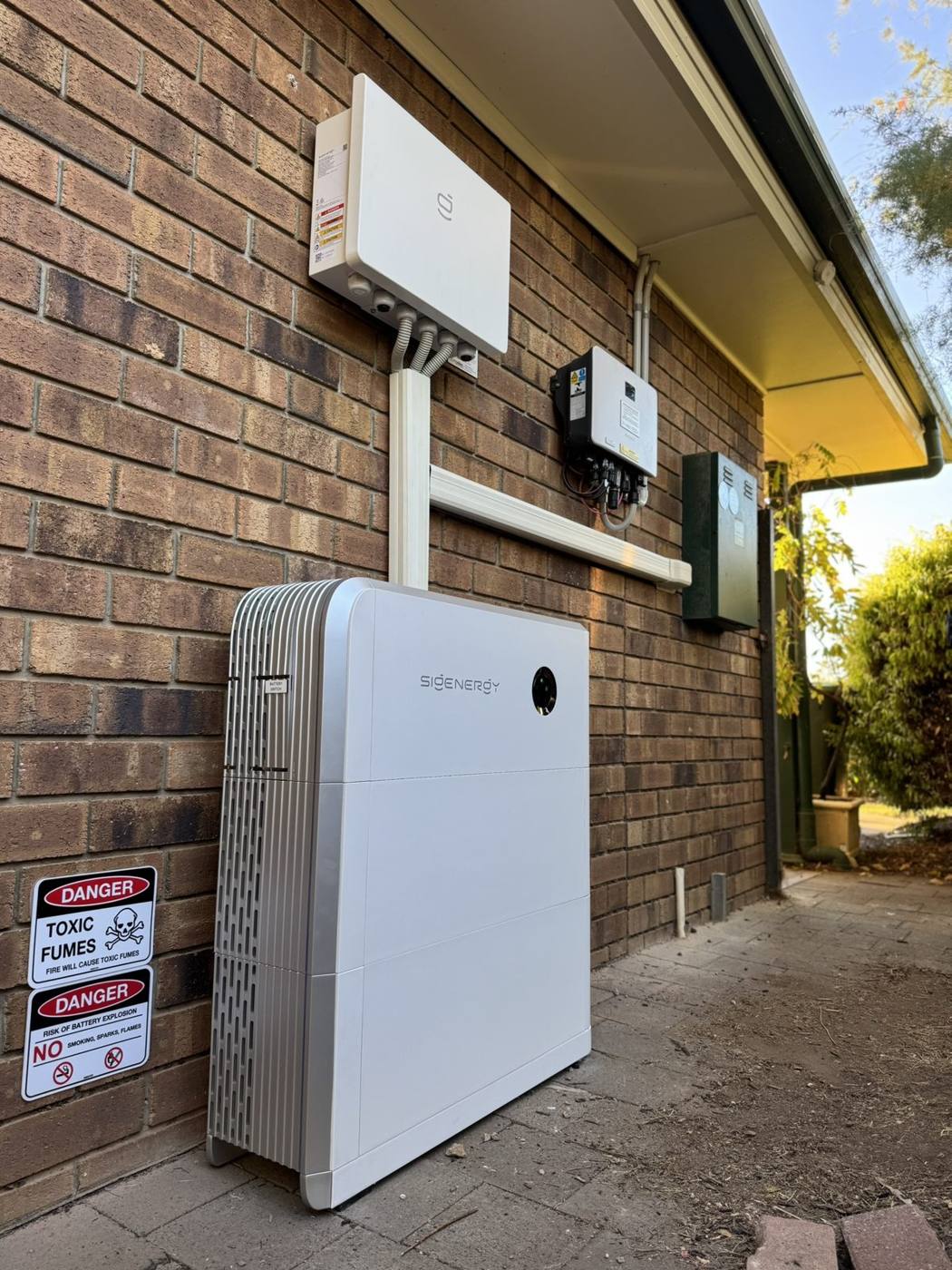
Size a solar battery to your evening and overnight use. Many Adelaide homes use roughly 8 to 15 kWh between sunset and sunrise, so 10 to 20 kWh usable often covers it. Go bigger for blackout backup, an EV charged overnight or a large household. Make sure your solar can fill it in winter, and compare usable capacity, not nominal.
- Size the battery to overnight use, not to your roof or the brochure.
- Most Adelaide homes suit 10 to 20 kWh usable.
- Compare usable capacity and continuous power between quotes.
- Your solar must be big enough to fill the battery in winter.
- The rebate is strongest on the first 14 kWh, then tapers.
Our calculator shows the figure before and after 1 January 2027.
Step 1: Work out your overnight use
A battery's job is to cover the power you use when the solar isn't making any. So the number you want is roughly what you use from late afternoon to the next morning.
Here's a simple way to estimate it:
- Take your average daily use from your bill (kWh per day).
- Estimate how much of that happens while the sun's up. If the house is empty during the day, it might be a third. If someone's home, it could be half.
- The rest is your overnight use. Add a little headroom for hot summer evenings.
If you already have solar, your bill only shows what you buy from the grid. Your inverter app usually shows the full picture, including what you use at night.
Check a summer and a winter bill if you can. Evening air con in January and heating in July can change your overnight number a lot, and the battery needs to suit both. If the numbers are hard to pull apart, send us your bills and we'll do it as part of a solar battery quote.
Battery size guide for SA homes
| Overnight use | Typical household | Usable battery to look at |
|---|---|---|
| Under 8 kWh | Couple, low evening use | Around 10 kWh, or check if a battery suits at all |
| 8 to 15 kWh | Most family homes | 10 to 20 kWh |
| 15 to 25 kWh | Big family, evening air con, pool | 20 to 30 kWh |
| 25 kWh plus | EV charged overnight, whole-home backup, three phase | 30 kWh plus |
For a feel of real systems, recent NG Elec installs include a 7.1 kW solar and 16 kWh GoodWe system in Hove, 12.75 kW with 24 kWh usable in Morphett Vale, and 18.3 kW with 35 kWh Sigenergy in Hayborough on three phase.
Send us a recent bill or your inverter app data. We'll call to talk it through, then send a free, itemised quote with the right size for your overnight use.
A worked example
Say your bill shows 22 kWh a day. You work during the day, so about a third, roughly 7 kWh, is used while the sun's up. That leaves about 15 kWh overnight.
A battery with around 15 to 18 kWh usable would cover most nights with a little in reserve. If you're planning an EV that you'll charge overnight, you'd look higher. If you mainly want to cut the evening peak and aren't fussed about backup, the lower end is fine.
Then check the solar side. Filling 15 kWh of battery and covering 7 kWh of daytime use needs over 22 kWh of solar on the day, which a 6.6 kW system won't do in an Adelaide winter. See how many solar panels you need.
Usable capacity, power and backup
Usable vs nominal capacity
Batteries can't safely use every last bit of their stored energy. The usable figure is what you actually get, so always compare usable kWh between quotes.
Continuous power (kW)
This is how much the battery can supply at once. On a hot evening with the oven, kettle and air con running, a battery with too little power output will pull the rest from the grid even when it's half full.
Backup during an outage
Backup has to be designed in. Most homes back up essential circuits, like the fridge, lights and internet, but whole-home backup is possible where the battery and switchboard allow. Backup needs more capacity if you want it to last.
What Adelaide conditions do to sizing
Two things shape battery sizing here. First, summer evenings: air con keeps running after the sun drops, which is exactly when a battery earns its keep.
Second, winter: Adelaide panels make about 2.4 kWh per kW per day in winter, around 40% of the 5.8 kWh they make in summer. A battery that fills easily in January may only half fill in July if the solar is small. We size the solar and battery together so it works across the year.
Is a bigger battery always better?
No. A battery that never gets fully used is money sitting on the wall. Bigger makes sense when you've got a known load coming, like an EV, when backup matters, or when you have a modular battery that's cheap to grow later.
The rebate plays a part too. The federal battery rebate pays the full rate on the first 14 kWh, 60% from 14 to 28 kWh and 15% from 28 to 50 kWh. So the first 14 kWh gets the strongest support per kWh, and it tapers above that. Our battery rebate guide has worked examples. We show the cost per kWh after the rebate on your quote so you can decide where the sweet spot is for you.
For a feel of real prices, typical NG Elec battery-only jobs in 2026 work out at roughly $350 to $600 per usable kWh after the rebate, incl GST. A 24 kWh GoodWe battery in Marden was about $10,300 after rebates, incl GST, a 32 kWh GoodWe on three phase in Seacombe Heights about $11,300, and a 52.6 kWh Sigenergy setup in Beaumont about $30,500. Every quote is itemised and free. See our price guide.
Sizing with Solar Sharer's free hours
Since 1 July 2026, SA retailers must offer at least one plan with free grid power from midday to 3pm, capped at 24 kWh a day. It's the federal government's Solar Sharer offer, it's opt-in and it needs a smart meter.
For sizing, it changes the winter problem above. If your solar is small, your roof can't fit a big array, or it's a run of cloudy July days, the battery can top itself up free between 12 and 3 and then run the house through the evening. So a battery sized to your overnight use can still fill on days your panels can't do it alone.
Two cautions. These plans usually carry higher daily supply charges and peak rates, so compare the whole bill. And the free window isn't a reason to oversize: the battery still only saves you money on kWh you actually use after dark. When we commission your battery we can set the charge schedule for the free window, and we size the system with it in mind. More in Solar Sharer free power.