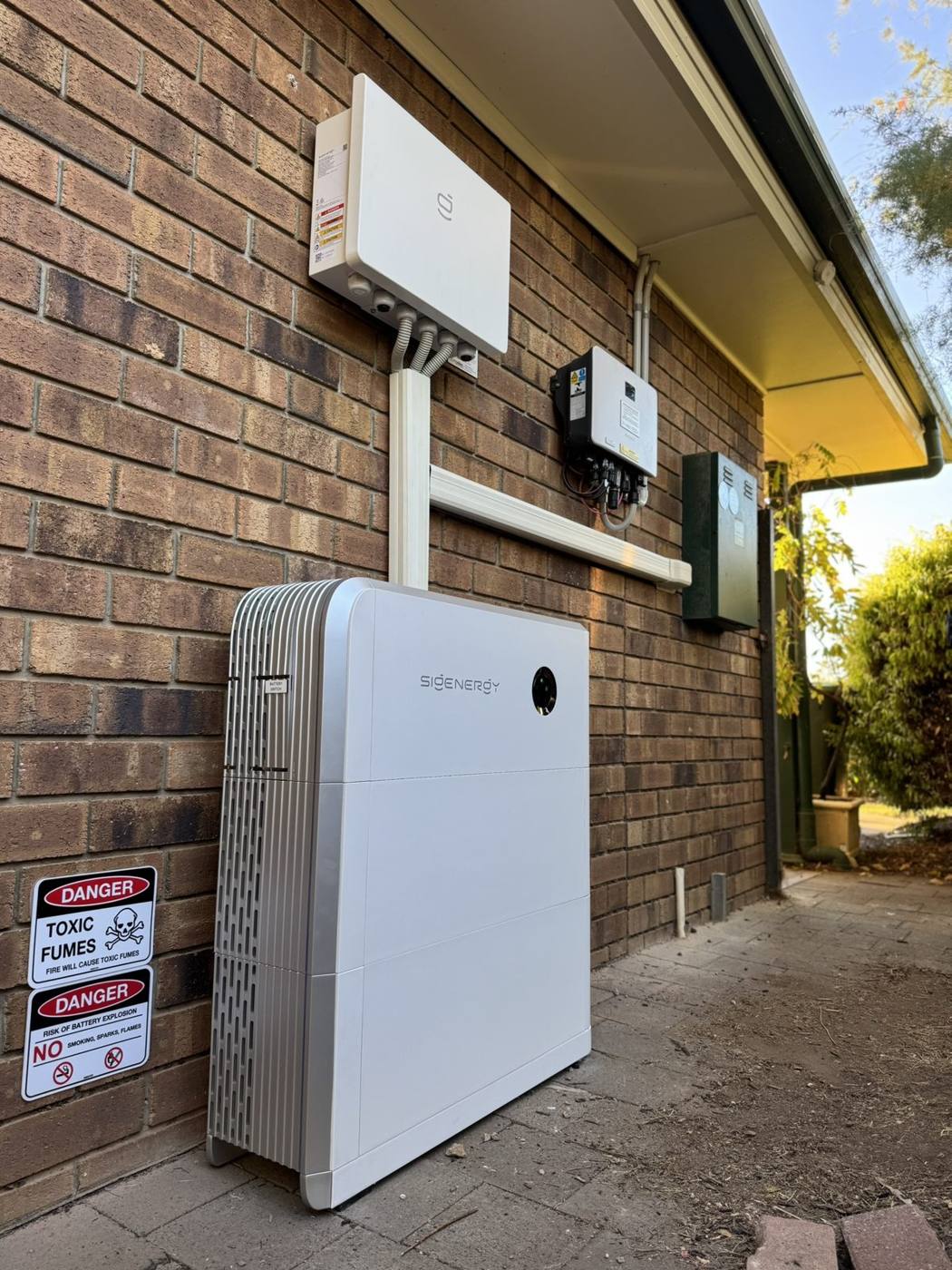
In 2026, a typical NG Elec solar and battery system in Adelaide costs about $14,000 to $25,000 after rebates, incl GST, starting from about $11,000 for an 8.4 kW system with a 14 kWh battery. Big three-phase systems with 35 to 52 kWh of storage run about $28,000 to $42,000. A battery added to existing solar is usually $10,000 to $14,500 after rebates, incl GST.
- Typical NG Elec solar and battery jobs in 2026: from about $11,000, most $14,000 to $25,000, after rebates incl GST.
- A battery added to existing solar: from about $9,000, most $10,000 to $14,500, roughly $350 to $600 per usable kWh.
- Battery size and brand, three phase, backup and switchboard work move the price most.
- The battery rebate drops on 1 January 2027 and the install date is what counts.
- Every quote is free and itemised, with $0 deposit options available.
Our calculator shows the figure before and after 1 January 2027.
Typical NG Elec prices in 2026
These ranges come from 73 jobs we booked in ServiceM8 between January and October 2026. They're approx, after STCs and the battery rebate at the 2026 rate, incl GST. In other words, what the customer actually paid.
Use the table to get a ballpark, then check the real jobs in the next section to see what each range actually bought.
| Job type | Typical price (after rebates, incl GST) |
|---|---|
| Solar and battery | From about $11,000. Most $14,000 to $25,000 |
| Big three-phase solar and battery (35 to 52 kWh) | About $28,000 to $42,000 |
| Battery added to existing solar | From about $9,000. Most $10,000 to $14,500 |
| 52 kWh three-phase Sigenergy battery (existing solar) | About $26,000 to $30,000 |
| Extra Tesla Powerwall 3 added to an existing Powerwall | From about $7,000 |
| Solar only, 5 to 6 kW | From about $5,000 |
| EV charger, 7 kW single phase, installed | About $2,200 to $2,800 |
| Inverter replacement | About $1,800 to $2,200 |
For batteries added to existing solar, that works out at roughly $350 to $600 per usable kWh after the rebate, incl GST. GoodWe usually sits at the lower end per kWh and Sigenergy higher. We've done fewer solar-only jobs this year, so treat that figure as a starting point rather than a range.
Ten real jobs and what they cost
Here are accepted NG Elec jobs from 2026. Suburb only, prices rounded, after rebates, incl GST.
| Suburb and month | System | Approx price |
|---|---|---|
| Greenwith, Oct 2026 | 8.4 kW solar + 14 kWh battery | About $10,800 |
| Hove, Sep 2026 | 7.1 kW solar + 16 kWh GoodWe | About $12,100 |
| Onkaparinga Hills, Sep 2026 | 8.7 kW solar + 24 kWh GoodWe, three phase, hot water on a solar timer | About $15,400 |
| Woodcroft, 2026 | 14.25 kW solar + 32 kWh GoodWe, old system removed | About $20,600 |
| Kangaroo Island, Oct 2026 | 8.7 kW solar + 26 kWh Sigenergy, replaced an existing system | About $24,900 |
| Hayborough, Aug 2026 | 18.3 kW solar + 35 kWh Sigenergy, three phase | About $28,700 |
| Marden, Sep 2026 | Battery only, 24 kWh GoodWe, backup on 3 circuits | About $10,300 |
| Seacombe Heights, Sep 2026 | Battery only, 32 kWh GoodWe, three phase, whole-home backup | About $11,300 |
| Noarlunga Downs, Aug 2026 | Battery only, 26 kWh Sigenergy, three phase, AC coupled, whole-home backup | About $14,600 |
| Beaumont, Aug 2026 | Battery only, 52.6 kWh Sigenergy, three phase, two inverters | About $30,500 |
Notice the Kangaroo Island job costs more than Woodcroft despite a smaller battery. That's brand, regional travel and replacing an old system, all in one line.
Send us a recent bill and we'll size solar and a battery to your use, with the 2026 rebate shown on the quote.
What moves the price
Two systems with the same kW and kWh can be thousands apart. These are the usual reasons:
- Battery size and brand. The biggest single factor. On our jobs, GoodWe is usually cheaper per kWh than Sigenergy.
- Single vs three phase. Three-phase homes can take bigger systems, and the gear often costs more.
- Backup. A few essential circuits costs less than whole-home backup.
- Old system removal. Taking off and disposing of an old array or inverter adds labour.
- Roof. Split roofs, steep pitches and two storeys take longer and need more safety gear.
- Switchboard. Old boards, or boards on asbestos panels, may need upgrading first. See our switchboard upgrades page.
- Cable runs and extras. Long runs from the board to the battery, or adding an EV charger.
- Regional travel. We cover all of SA, and jobs further out carry travel costs.
Our guide to what goes into a solar quote goes deeper on each one.
Why cheap quotes look so different
If one quote is thousands below the rest, it's usually not the same job. Check these before you compare:
- Usable vs total battery capacity. The rebate and your evening power both depend on usable kWh. Make sure both quotes show it.
- What's backed up. "Backup" can mean one circuit or the whole house.
- Switchboard work. Some quotes leave it out, then add it on install day.
- Brand and model. Panels, inverter and battery should be named, not "tier 1" or "or equivalent".
- The rebate line. It should be a clear line based on usable capacity, not "rebate included".
- Who does the work. Ask who installs, who signs it off and who you call if something goes wrong.
The easiest fix is to ask every installer to quote the same thing: the same usable battery size, the same backup, and switchboard work either in or clearly out. Then the gap usually shrinks or explains itself.
Every NG Elec job has licensed electricians on it, and we design, manage and sign off every job. Installs carry our lifetime workmanship warranty.
Rebate timing: prices go up on 1 January 2027
The battery rebate is the federal Cheaper Home Batteries Program, taken off your quote through STCs. It steps down every January and July until the end of 2030. The next drop is 1 January 2027.
The full rate is 6.8 STCs per usable kWh for the rest of 2026 and 5.7 from January, with certificates rounded down. At an assumed $38 per STC, that's about $258 per kWh now and about $217 from January. Using those estimates:
- 14 kWh battery: about $3,610 rebate in 2026, about $3,000 from January. Roughly $610 less.
- 20 kWh battery: about $4,520 in 2026, about $3,800 from January. Roughly $720 less.
The gear doesn't get cheaper on 1 January, so that drop shows up in what you pay. These are estimates at about $38 per STC, and STC prices move. We confirm the exact figure on your quote.
The install date counts, not the quote date. If you want the 2026 rate, get your quote in early so there's room to book the install. Our battery rebate guide has the full tier table.
How three free hours a day change battery value
Since 1 July 2026, SA electricity retailers must offer at least one plan under the federal government's Solar Sharer offer with three hours of free grid power every day. In SA the window is midday to 3pm, capped at 24 kWh a day. You need a smart meter and you have to choose the plan.
With a battery, that changes things. On cloudy winter days, or if your array is on the small side, the battery can top itself up free between 12 and 3, then run the house through the evening peak. That means a smaller roof doesn't have to mean a small battery.
It also changes how we size. We look at whether the free window can fill the gap your panels leave in winter, and when we commission the battery we can schedule grid charging in the window if you're on a Solar Sharer plan.
The catch: these plans usually have higher supply charges and peak rates, so compare the total cost. More in our Solar Sharer guide.
$0 deposit and free, itemised quotes
We offer $0 deposit options and flexible payment options, so you don't need the full amount up front. We'll talk you through the options when we quote.
Every quote is free and itemised. You'll see each panel, inverter and battery by brand and model, the rebate as its own line, and any switchboard or backup work spelled out. No surprises on install day.
Want your own number? Send us a recent power bill through the quote form and we'll size a system to how you actually use power.