Almost any solar system can take a battery. You either add a battery with its own inverter next to your existing one (AC coupling) or replace the inverter with a hybrid that runs panels and battery together. Which suits depends on your inverter's age, how much solar you export and whether you want blackout backup. Batteries added to existing solar still qualify for the federal battery rebate.
- Almost any existing solar system can take a battery.
- AC coupling keeps your inverter; a hybrid swap replaces it.
- The real limit is how much spare solar you have, especially in winter.
- Size the battery to overnight use, typically 10 to 20 kWh.
- Batteries added to existing solar still get the federal rebate.
Our calculator shows the figure before and after 1 January 2027.
AC coupled or hybrid: the two ways to do it
There are two ways to add a battery to solar you already have. Here's how they compare:
| AC coupled battery | Hybrid inverter swap | |
|---|---|---|
| Keeps your inverter | Yes | No, it's replaced |
| Best for | Newer inverters that are working well | Older inverters, or adding panels at the same time |
| Blackout backup | Available on many models | Available on most models |
| Efficiency | Slightly lower (extra conversion step) | Slightly higher |
If your inverter is getting on and you're thinking about more panels anyway, a hybrid swap often makes sense. If your inverter is fairly new and healthy, an AC coupled battery lets you keep it.
There's a third path for people who want to keep things simple: replace the whole system with a new hybrid solar and battery setup. That's worth considering if your panels are old, damaged or much smaller than what you'd install today. We'll show you the options side by side so you can weigh up keeping what you've got against starting fresh.
Is your solar big enough to fill a battery?
This is the big one. A battery is filled by the solar you'd otherwise export to the grid. If you've got a small, older system, say 3 to 5 kW, and you use a fair bit during the day, there may not be much left over to charge it.
Winter makes it harder. Adelaide panels make roughly 40% of their summer output on an average winter day. A system that exports plenty in January might export very little in July.
In that case, adding panels alongside the battery usually makes a bigger difference to your bill than the battery alone. See how many solar panels you need for the sizing side.
There's another option now too. On a Solar Sharer plan, SA retailers give you free grid power from midday to 3pm, capped at 24 kWh a day. If your solar is small, your roof is full, or it's a cloudy winter week, the battery can top up free in that window and run the house through the evening. When we commission the battery we can set the charge schedule for it, if you're on one of these plans. Those plans usually have higher supply and peak charges, so compare the total cost. More in Solar Sharer free power.
Send us a photo of your inverter and a recent bill. We'll call to talk it through, then send a free, itemised quote.
What we check before quoting
- Your inverter: brand, model, age and condition. This decides AC coupled or hybrid.
- Your export data: how much solar you're sending to the grid now, across summer and winter.
- Your switchboard: whether it has room and the right protection, especially if you want backup.
- Where the battery goes: wall space, clearances and keeping it out of harsh afternoon sun.
- Your SA Power Networks connection: phase and export limits, as any change needs approval.
A photo of your inverter and switchboard plus a recent bill is usually enough for us to give you a solid first answer.
What size battery to add
Size it to your evening and overnight use, not to your solar. Many homes use somewhere around 8 to 15 kWh between sunset and sunrise, so a battery of roughly 10 to 20 kWh often covers it. Your own bills are the real guide.
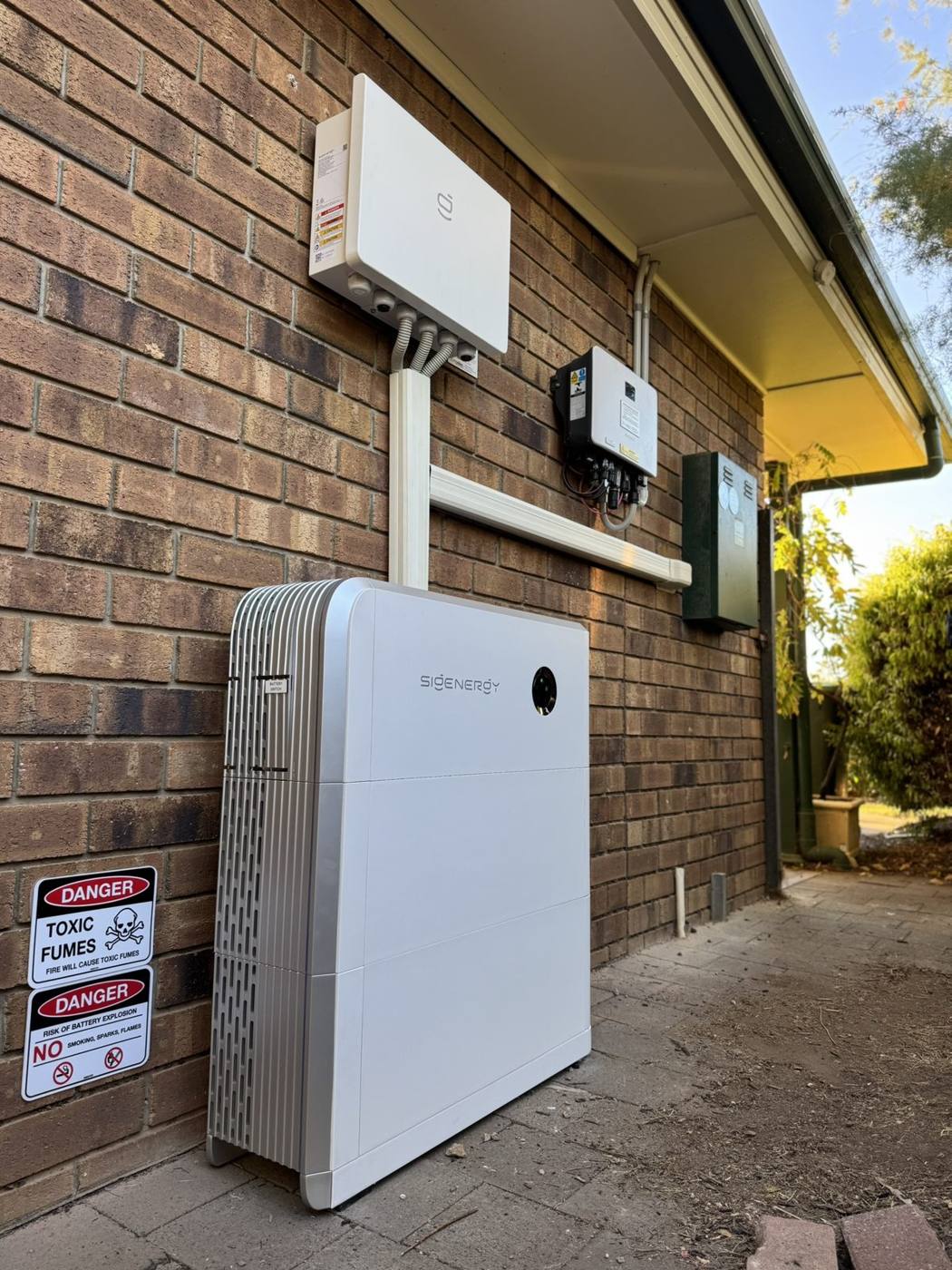
Going bigger makes sense for blackout backup, an EV charged overnight or a big family. As a real example, we added a 26.3 kWh Sigenergy battery to an existing solar system in Seaford Heights. Our battery sizing guide goes into the detail.
Will it keep the power on in a blackout?
Not every battery setup does. Backup has to be designed in. We can set it up to cover essential circuits, like the fridge, lights, internet and a few power points, or the whole home where the battery and switchboard allow.
Backup sometimes needs switchboard work. If it does, we quote it upfront as its own line so there are no surprises.
Cost, rebate and warranty
On typical NG Elec jobs in 2026, a battery added to existing solar starts from about $9,000 (24 kWh usable GoodWe), and most land between $10,000 and $14,500, after rebates, incl GST. A 26 kWh Sigenergy battery AC coupled with whole-home backup on three phase in Noarlunga Downs was about $14,600, and a 52 kWh three phase Sigenergy setup is about $26,000 to $30,000. Every quote is itemised and free. See our price guide.
Where yours lands depends on the battery, its size, whether the inverter is changing and any switchboard work. The federal Cheaper Home Batteries Program applies to batteries added to existing solar, and it's taken off the quote. It steps down next on 1 January 2027, and the install date is what counts. Our battery rebate guide explains the tiers.
On warranty: adding a battery doesn't automatically affect your panels, but if your inverter is replaced, its old warranty no longer matters and the new one takes over. We install to the manufacturer's requirements so their warranties aren't put at risk, and our workmanship is covered for life.
Is adding a battery worth it?
It depends on how much solar you're exporting and how much power you use after dark. A battery stores solar you'd otherwise sell for a low feed-in credit and uses it in the evening instead of buying from the grid.
It tends to stack up best when:
- You export a lot of solar during the day.
- You use a fair bit in the evening and overnight, like air con, cooking or an EV.
- You want blackout backup for the fridge, internet or medical equipment.
It's harder to justify when your solar is small and barely covers daytime use, or your evening use is low. We'll tell you straight if panels first would be the better spend. Our battery payback guide shows how to run the numbers on your own bills.