To go off-grid in South Australia you need a solar array sized for June and July, not summer, a battery sized for your overnight use plus cloudy days, an off-grid inverter-charger, and an auto-start generator for long cloudy runs. Price depends on your daily usage, battery size, mounting and cable runs, so get a site-specific, itemised quote.
- Size off-grid solar for June and July: Adelaide winter output is about 40% of summer.
- Oversize the array as well as the battery so it can recharge on short days.
- An auto-start generator is the backup almost every full-time off-grid site needs.
- Cost depends on usage, battery size, mounting and cable runs, so get an itemised quote.
- Already on the grid? A battery with backup is often the better first step.
What does an off-grid solar system include?
An off-grid system is a small power station for your property. Nothing comes from SA Power Networks, so every part has to be sized and matched properly.
- Solar array. Roof, shed or ground mounted. Ground mounts let us set the angle for winter and keep panels easy to reach.
- Battery. Stores the day's solar for the night and for cloudy days. We use brands like Sigenergy, BYD and others depending on the design.
- Off-grid inverter-charger. Runs the house, charges the battery and controls the generator. We're a Selectronic accredited integrator and also build with Sigenergy.
- Backup generator. Ideally auto-start, wired into the inverter so it kicks in when the battery runs low.
- Switchboard, cabling and protection. Built to the relevant Australian standards for stand-alone power systems and batteries.
- Monitoring. Where the gear supports it, so you can see what the system is doing from a phone.
How do you size off-grid solar for an SA winter?
Size it for the worst week of the year, not the average one. In Adelaide a panel makes about 5.8 kWh per kW per day in summer but only about 2.4 in winter, roughly 40% of summer.
| Array size | Typical summer day | Typical winter day |
|---|---|---|
| 10 kW | about 58 kWh | about 24 kWh |
| 15 kW | about 87 kWh | about 36 kWh |
| 22.8 kW | about 132 kWh | about 55 kWh |
Those are averages. A run of grey days in July can drop well below them, which is why the battery and generator matter.
Start with real usage
If you're on the grid now, your bills tell us your daily use. For a new build we list every appliance, how long it runs and when. Big loads like air con, bore pumps and welders change the design a lot.
Oversize the array, not just the battery
A big battery is no use if the panels can't fill it on a short winter day. Adding panels is usually the cheaper way to cut generator hours.
Leave room to grow
Plenty of off-grid jobs start with a shed and add a house later. Design the inverter and battery so you can add to them.
Tell us about your property and how you'll use it. We'll design for winter and give you an itemised quote.
Do you still need a generator off-grid?
For a full-time home or business, yes. Even a well-sized system will hit a long cloudy spell eventually. The generator is the insurance policy.
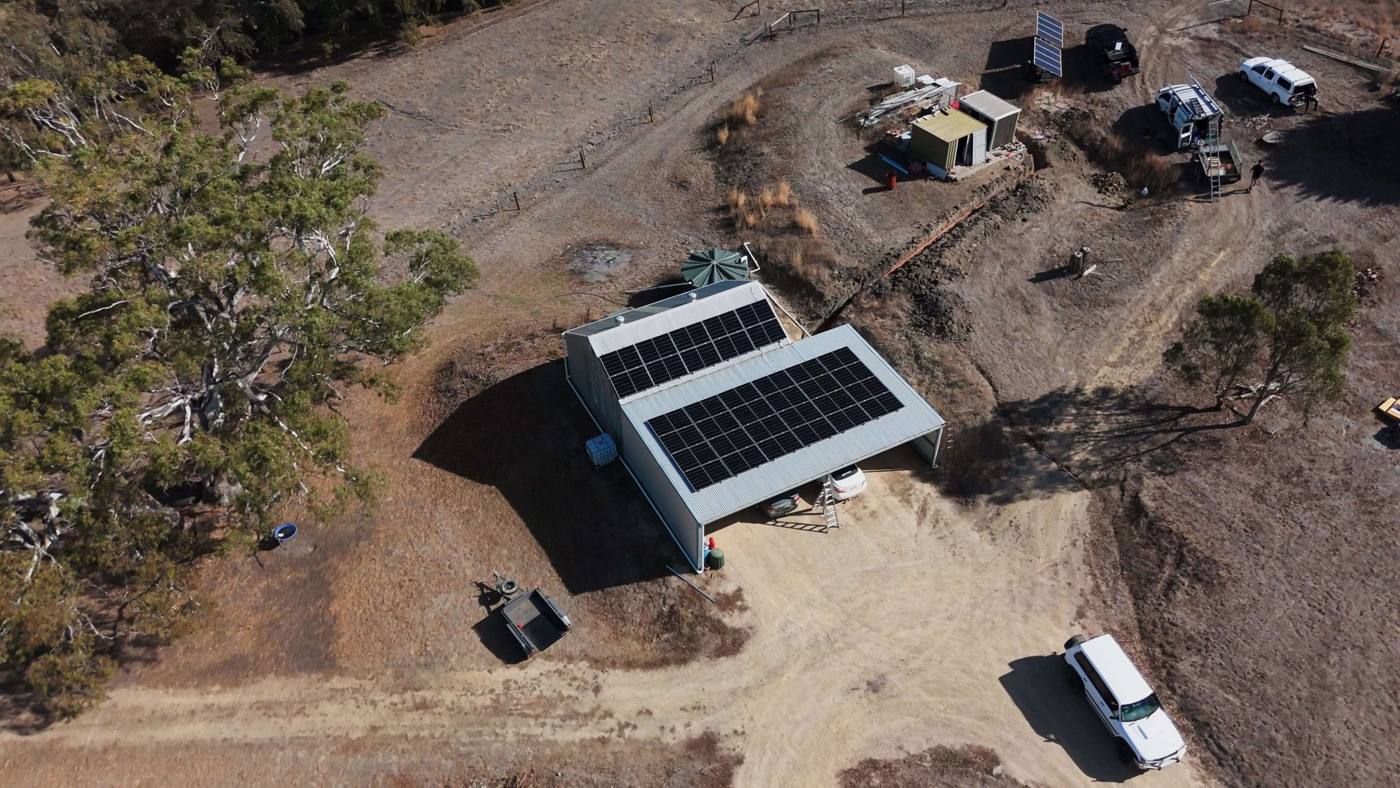
The best setup is an auto-start generator controlled by the inverter. When the battery drops to a set level, it starts, charges the battery and shuts down again. Nobody has to walk out to the shed at 2am. Our Mount Jagged build uses an 8 kVA auto-start generator for exactly this.
A smaller weekender or a shed-only system can sometimes skip the generator if you're happy to cut back usage on grey days. We'll talk that through honestly.
What real SA off-grid builds look like
Here are two of our recent off-grid jobs so you can see the scale involved.
| Mount Jagged | Kangaroo Island | |
|---|---|---|
| Use | Two Airbnbs | New shed, home planned later |
| Solar | 22.8 kW (48 x 475W Jinko) | Designed to suit the shed now and the house later |
| Battery | 52 kWh, plus 8 kVA auto-start generator | Battery and inverter sized for the site |
| Install | Ground mount on driven piles, underground cabling, 5 days | Design to commissioning, 1 day on site |
Read the full Mount Jagged off-grid project and the Kangaroo Island off-grid build. We've also built off-grid at Hindmarsh Valley and Kangarilla.
What does it cost to go off-grid in SA?
We don't publish a price because two off-grid systems are rarely alike. A small shed system and a full-time family home are completely different jobs. What drives the price:
- Your daily energy use, especially in winter
- How many cloudy days you want the battery to cover
- Battery size and brand
- Roof, shed or ground mount (piles and frames add cost)
- Distance from the array to the house, and trenching
- Generator size and whether you already have one
- Site access and travel for regional jobs
Solar STCs often still reduce the price, and we'll check whether any battery rebate applies to your setup. We'll show exactly what applies on your quote. Every quote is free and itemised, with $0 deposit and flexible payment options available.
Can you go off-grid if you're already on the grid?
You can, but for most suburban homes it isn't the smartest first step. Disconnecting means arranging it with your retailer and SA Power Networks, and you lose the grid as a free backup.
A grid-connected solar battery with backup often gets you most of the independence for less. Off-grid makes the most sense where there's no grid, or where a new connection would cost a lot.
What you need before going off-grid
- Power bills or a full appliance list
- A rough site plan showing where the house, shed and array could go
- A decision on full-time or part-time use
- Any council or development approval checks for ground mounts or new buildings
- A Solar Accreditation Australia (SAA) accredited installer who designs off-grid regularly
- A plan for generator servicing and system checks
We service all of South Australia, including Kangaroo Island, the Flinders, Eyre and Yorke Peninsulas and the South East. See our off-grid solar service for more.