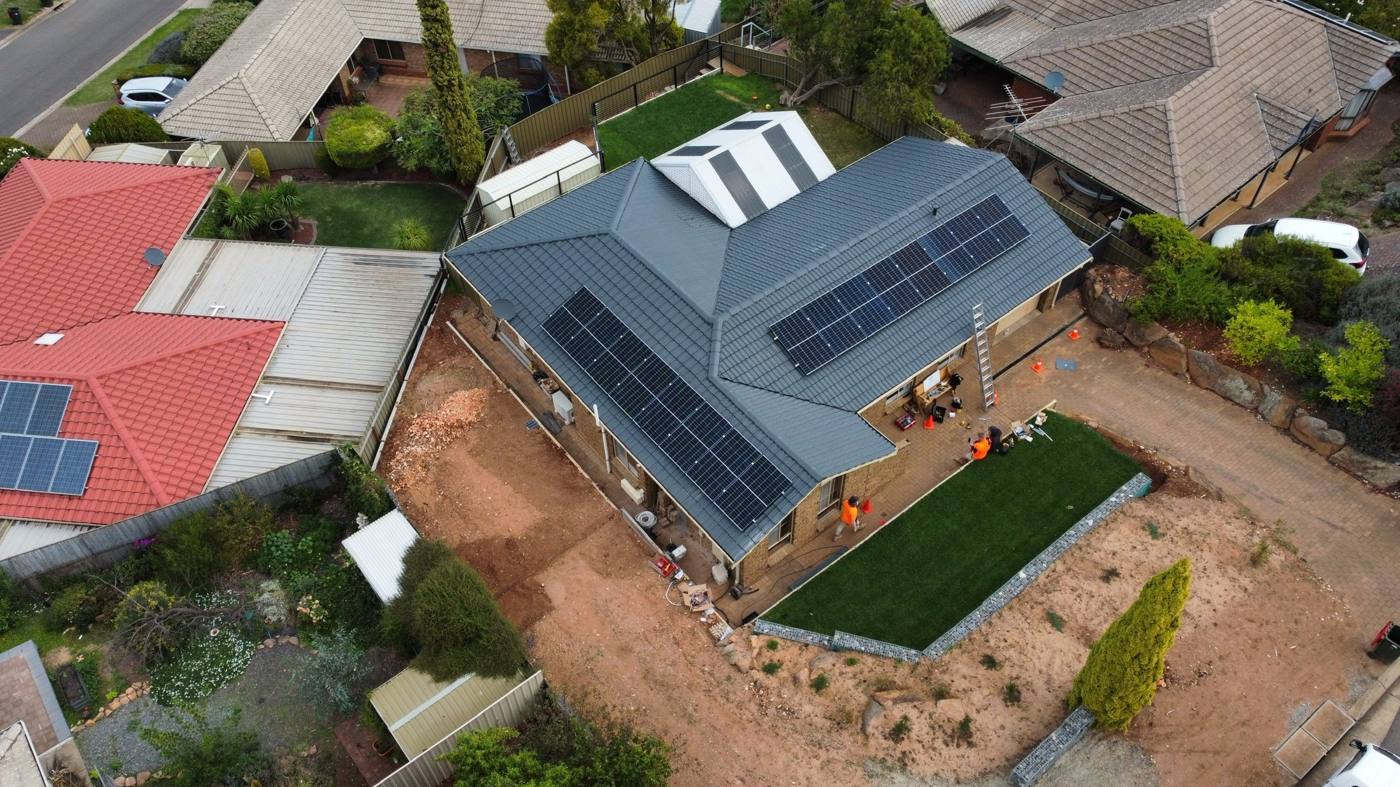
For maximum yearly output in Adelaide, face PV panels north at roughly 30 to 35 degrees. Flatter panels favour summer and steeper ones favour winter. Most pitched roofs work well as they are, east and west roofs are a good option with batteries or time-of-use tariffs, and flat roofs should be tilted at least about 10 degrees so rain can wash them.
- The ideal yearly tilt in Adelaide is about 30 to 35 degrees facing north.
- Most Adelaide roofs are flatter than that and still work well.
- Direction and shade matter more than a few degrees of tilt.
- East and west arrays suit homes with batteries or afternoon usage.
- Tilt flat-roof panels at least about 10 degrees so rain can clean them.
Why panel angle matters
Panels make the most power when sunlight hits them square on. The sun sits high in an Adelaide summer and low in winter, so no single fixed angle is perfect all year.
The good news is that output changes gradually. A few degrees either way makes little difference. Direction, shade and design matter more than chasing the perfect tilt.
Think of it as a list of priorities. First, avoid shade. Second, use the best-facing roof space you have. Third, worry about tilt. Get the first two right and the angle rarely makes or breaks a system.
What's the best angle in Adelaide?
| Goal | Rough tilt, facing north | Why |
|---|---|---|
| Most energy over the year | 30 to 35 degrees | Close to Adelaide's latitude of about 35 degrees south. |
| More summer output | Flatter, 10 to 25 degrees | Catches the high summer sun. Most Adelaide roofs already sit here. |
| More winter output | Steeper, 45 to 60 degrees | Catches the low winter sun. Useful for off-grid. |
| Flat roofs | At least about 10 degrees on a tilt frame | Lets rain run off and wash dust away. |
In Adelaide, panels make about 5.8 kWh per kW per day in summer and about 2.4 in winter. That gap is mostly the shorter days and lower sun, not something tilt alone can fix.
Send us your address and a recent bill. We'll design around your roof angle, direction and shade.
Roof direction matters more than tilt
- North gives the most energy over a day and a year.
- East starts earlier and suits households that use power in the morning.
- West produces into the late afternoon, when air con runs and grid power often costs more.
- East and west together spread production across the day. With a home battery or time-of-use tariff, that can be worth more than a north-only array.
- South is the weakest in Adelaide. We'll only suggest it if there's no better option and the numbers still stack up.
Summer vs winter: why tilt is a trade-off
In Adelaide the sun climbs high in December and sits low in June. A flat panel faces the summer sun well but catches less in winter. A steep panel does the opposite.
For most grid-connected homes, summer output matters a lot because that's when air con runs and solar can cover it. So the flatter pitch of a typical Adelaide roof often suits real life better than the textbook angle suggests.
Off-grid is different. With no grid to fall back on, winter is the hard part of the year, so we design for June and July. That's when a steeper tilt earns its keep.
Battery owners sit in between. A battery stores the midday surplus for the evening, so a steady spread of production across the day, and across the year, is worth more than one big summer peak.
What else affects your solar output
Shade
Shade from trees, chimneys or the neighbour's second storey costs far more than a poor angle. Tigo optimisers can limit the damage when some shade can't be avoided.
Heat and airflow
Hot panels make less power. Leaving a gap under the panels helps them stay cooler.
When you use power
If you're home in the afternoon, west-facing panels may suit you better than squeezing everything onto the north roof.
System design
Panels on different roof faces need to be wired to separate inverter inputs or optimised, so one face doesn't drag the other down.
Should you use tilt frames?
On a pitched roof, usually not. Tilt frames add cost, add wind load and can look out of place, and the extra output is often small.
They're worth it on flat roofs, which are common on commercial buildings and some carports, and on ground mounts. For off-grid systems we often set ground-mounted arrays steeper on purpose, because winter is when power is shortest.
Can panels still work if the angle isn't perfect?
Yes. The vast majority of Adelaide homes have roofs that aren't at the ideal angle, and they still make good use of solar. If your roof is flatter or faces east or west, we can adjust the number of panels, the layout and the inverter to suit.
Every quote we do starts with your roof, shading and how you use power, so you know what to expect before you commit. See our residential solar page.
If your roof is a poor fit, the fix is usually more panels or a different layout, not expensive frames. Panels are now a small part of the system cost, so adding one or two to make up for a flatter or east-facing roof is often the cheapest answer.