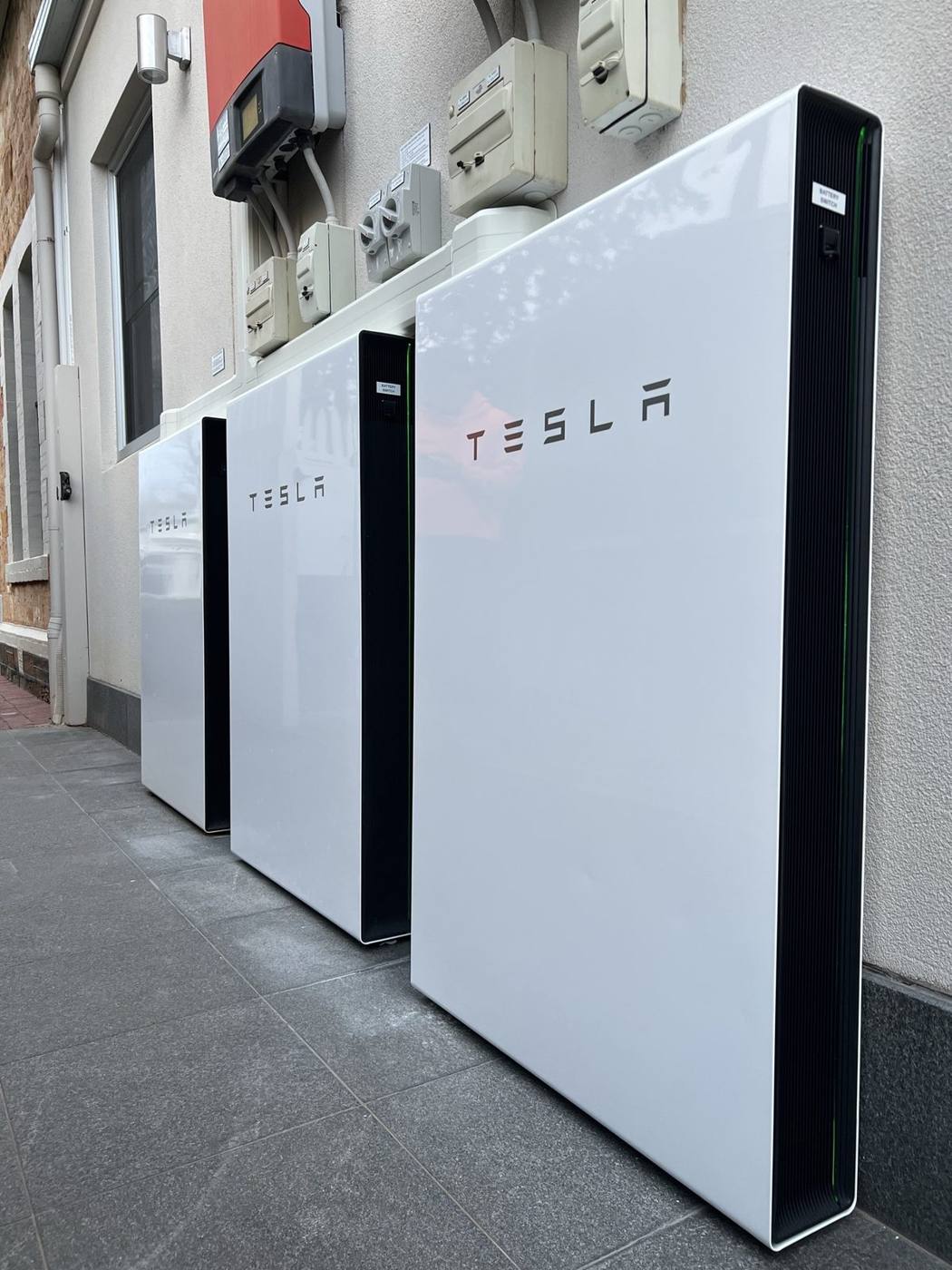
Tesla Powerwall is a single-unit home battery with 13.5 kWh usable per unit, according to Tesla. Installing one in Adelaide means a site assessment, deciding between essential-circuit and whole-home backup, any switchboard upgrades, SA Power Networks approval and commissioning. It qualifies for the federal Cheaper Home Batteries Program when installed by an accredited installer. One Powerwall suits many homes; bigger loads may need two.
- Powerwall is a single-unit battery; Tesla lists 13.5 kWh usable per unit.
- One suits many homes; higher use or whole-home backup may need two.
- Backup scope (essential or whole home) drives the wiring and switchboard work.
- It qualifies for the federal battery rebate, estimated at about $3,460 for one unit in 2026 (at about $38 per STC).
- NG Elec is a Tesla Certified Installer and SAA accredited.
Our calculator shows the figure before and after 1 January 2027.
What a Powerwall is and who it suits
Powerwall is Tesla's home battery. Unlike modular batteries, it's one complete unit. Tesla lists 13.5 kWh of usable capacity per unit. If you need more, you add another Powerwall rather than stacking modules.
It suits people who want strong blackout backup, one well-known product and a polished app. It's not always the cheapest per kWh, so we often quote it next to a modular option like Sigenergy so you can compare. Our best solar battery comparison covers how they stack up.
Tesla specs change between models and markets, so we always work from the current Australian datasheet for your quote.
How many Powerwalls do you need?
Start with your overnight use. Many homes use somewhere around 8 to 15 kWh between sunset and sunrise.
| Your situation | Usually suits |
|---|---|
| Overnight use up to about 13 kWh, essential-circuit backup | One Powerwall |
| Higher evening use, an EV charged overnight, or whole-home backup on a bigger house | Two Powerwalls |
| Large home, three phase, long backup periods | Two or more, designed case by case |
Run time in a blackout depends on what's running, not just the battery size. A fridge, lights and internet will last a long time. Ducted air con on a hot night won't. Our battery sizing guide shows how to work out your number.
Send us a recent bill and tell us what you want backed up. We'll call to talk it through, then send a free, itemised quote with the rebate applied.
Backup: essential circuits or whole home
Backup is a wiring decision as much as a battery one. There are two common setups:
- Essential circuits: the fridge, lights, internet and a few power points stay on. Cheaper to wire and makes the battery last longer in an outage.
- Whole home: everything stays on, within the battery's power limits. Needs the switchboard and battery to suit, and often more capacity.
We talk through which circuits matter to you, like a bore pump on a rural block or medical equipment, and design the backup around that.
If you're on a rural block with a bore or a property that loses power often, whole-home backup or a second unit is worth a closer look. We'll talk through the trade-off between backup coverage and cost.
What the installation involves
- Site assessment. We check where the Powerwall can go, clearances, exposure to afternoon sun, your switchboard and your existing solar.
- Design and quote. Number of units, backup scope, any switchboard work, and how it connects to your existing panels. Every quote is free and itemised.
- Approval. We handle SA Power Networks approval for the connection.
- Install and commissioning. Licensed electricians install and test it, show you how it works in the Tesla app, and we sign off the job.
Powerwall works with existing solar. Depending on your setup, your panels can stay on your current inverter or be connected through the Powerwall. We'll explain which suits your system.
Where a Powerwall can go
Most Powerwalls in Adelaide go on a garage wall or an outside wall near the switchboard. Where it goes affects the cost and how well it runs.
- Out of harsh afternoon sun. A shaded wall or the garage is better than a west-facing wall baking in summer.
- Clearances. Tesla and Australian standards set distances from doors, windows and other equipment. We check them on the site visit.
- Close to the switchboard. Shorter cable runs keep costs down.
- Protected from vehicles. In a garage, it may need a bollard so the car can't bump it.
If your preferred spot doesn't work, we'll show you the options and what each one costs.
The battery rebate on a Powerwall
Powerwall qualifies for the federal Cheaper Home Batteries Program when installed by an accredited installer. The rebate is taken off your quote through STCs, so there's nothing to claim.
It's tiered by usable capacity: full rate on the first 14 kWh, then 60% up to 28 kWh. The full rate is 6.8 STCs per usable kWh for the rest of 2026 and 5.7 from 1 January 2027, with certificates rounded down. At an assumed $38 per STC, that's about $258 per kWh now and about $217 from January. On those estimates, one Powerwall 3 at 13.5 kWh attracts about $3,460 in 2026 (about $2,890 from January), and two at 27 kWh about $5,620 (about $4,710 from January). STC prices move, so these are estimates, and your quote shows the exact amount. See our battery rebate guide for the full detail.
Already have a Powerwall and want more storage? On typical NG Elec jobs in 2026, adding an extra Tesla Powerwall 3 to an existing Powerwall starts from about $7,000, after rebates, incl GST. A first Powerwall depends more on backup scope and switchboard work, so we quote it on your home. Every quote is itemised and free. See our price guide.
For your own figure, use our battery rebate calculator.
Choosing a Powerwall installer
- Tesla Certified Installer. NG Elec is one. See our Tesla Powerwall installer page.
- SAA accreditation so the rebate applies, plus NETCC approved seller status.
- A licensed electrical contractor who can handle the switchboard and backup wiring. Ours is PGE285103, with $20M public liability.
- Support after install. Someone local to call if settings need a tweak. Our installs carry a lifetime workmanship warranty.
We install Powerwalls right across South Australia, from metro Adelaide to the Fleurieu, Hills and regional SA.